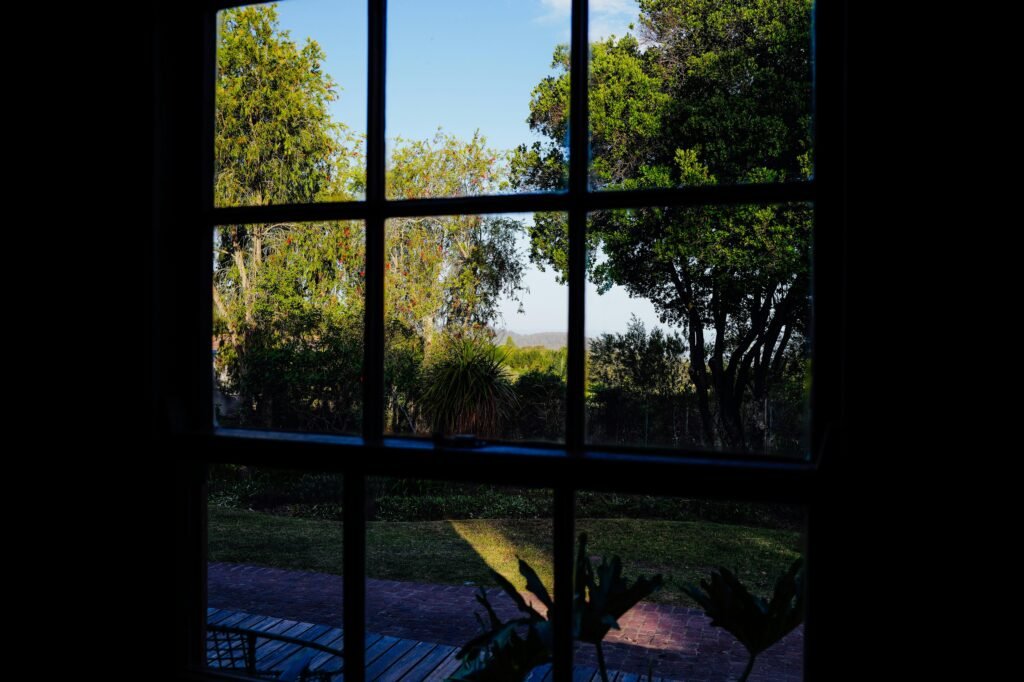
Why British Homes Keep Getting Darker
We know that natural light profoundly affects our health, mood and productivity. We also know that Britain’s housing stock is among the gloomiest in Europe. So why do we keep building, and decorating, homes that make the problem worse?
Britain has a light problem. Not a shortage of daylight, though the latitude does not help, but a persistent, historically embedded tendency to design, build and furnish homes in ways that minimise rather than maximise the light available. It is a tendency that runs from Victorian terrace planning to contemporary planning regulations, from the orientation of new-build estates to the deep, dark sofas and heavy curtains that continue to feature prominently in the most popular interior aesthetics.
The consequences are not merely aesthetic. Light (natural, full-spectrum, circadian-rhythm-calibrated light) is arguably the single most important environmental variable in human health. The relationship between inadequate light exposure and depression, insomnia, compromised immune function and reduced cognitive performance is among the most robustly evidenced in environmental medicine. And yet the British home, in 2025, is not notably brighter than it was in 1975. In some respects, it is darker.
The Architecture of Gloom
The origins of Britain’s domestic light problem are structural and historical. The Victorian and Edwardian terraced housing that comprises the majority of the UK’s older housing stock was designed for a different relationship with domestic space: rooms were smaller and more numerous, servants occupied back quarters, social life was conducted in formal front rooms that were often kept shuttered for propriety, and the window tax, repealed in 1851 but still culturally influential for decades, had bred a residual anxiety about large openings in external walls.
Contemporary planning regulations compound the problem. Permitted development rights govern how far rear extensions can project without planning permission, how large windows can be, and what impact development can have on neighbours’ light, reasonable constraints in a densely populated country, but ones that frequently prevent homeowners from making the alterations that would most improve their light environment.
New-build housing presents its own paradoxes. While modern buildings are theoretically unconstrained by the small windows of the Victorian inheritance, the economics of land and construction conspire against generous fenestration. Window openings are expensive. Floor-to-ceiling glazing requires high-performance glass to meet energy performance standards. The average new-build dwelling, built to minimum regulatory standards and maximum occupancy, does not prioritise the luminous.
“We have decades of research on what light does to human beings. We build and decorate as though we have never heard any of it.”, Dr Marcus Webb, lighting researcher
How We Make It Worse
Architecture aside, British decorating culture has made a consistent set of choices that reduce available light. The sustained popularity of dark, saturated wall colours (from the Farrow & Ball era of the 2010s to the current vogue for forest green, deep burgundy and Prussian blue) is a deliberate aesthetic embrace of gloom that the marketing language has made romantic: ‘cosy’, ‘enveloping’, ‘moody’.
These colours are beautiful. Many spaces in which they appear are genuinely inviting. But they absorb light rather than reflecting it, and in rooms that already struggle with natural light (the north-facing terrace living room, the basement flat, the inner bedroom with its small Victorian sash) they can reduce effective light levels to the point where artificial lighting is required throughout the day.
Heavy window treatments compound the problem. The draped curtain, a symbol of domestic cosiness deeply embedded in British visual culture, blocks light even when ostensibly open, particularly when the fabric is heavy and the heading generously gathered. The fashion for roller and Roman blinds that ‘block out’ light entirely reflects an anxiety about privacy that has perhaps been too readily accommodated: many British homes can achieve near-total darkness at midday, which is useful for sleeping infants and daytime television, but is not obviously serving the household’s circadian health.
The Scandinavian Counter-Evidence
It is instructive to look northward for comparison. Scandinavian countries, which face considerably shorter winter days than the UK, have developed a domestic culture that treats light not as a decorative choice but as a health resource requiring active management. Pale, reflective wall surfaces. Minimal window treatments or none at all, privacy achieved through the placing of furniture and planting rather than fabric. Layered artificial lighting designed to compensate for seasonal darkness rather than merely illuminate functional tasks. A cultural attitude to candle-light as supplementary rather than sufficient.
The result is interiors that, despite similar climatic constraints, feel measurably lighter than their British equivalents. Research by the European Federation of Lighting Designers found that average measured light levels in Nordic domestic interiors are significantly higher than in British equivalents, even in winter, when adjusted for natural light availability.
The Path to Brighter Homes
There are practical interventions available at every budget level. At the simplest: lighter wall colours, even a shift from a mid-tone to a light tone in the same colour family can increase the reflective qualities of a room significantly. At the moderate: improved window treatments, particularly replacing heavy curtains with lighter alternatives that can be fully retracted, and replacing overhead lighting with layered sources positioned at a height that illuminates the room’s reflective surfaces.
At the structural: rooflights and sun tunnels, which can introduce natural light to previously dark interior spaces, have become more accessible in both cost and planning terms. Side return extensions, common in London and other cities, typically introduce significantly more light than the rooms they replace. And the simple, underappreciated act of keeping windows clean, which research suggests increases light transmission by up to 30 percent in older housing stock, costs nothing at all.
The light is there. We have simply organised our buildings, our regulations and our aesthetics around not letting it in. That is a choice. It is also, given what we know about light and human health, a choice worth revisiting.