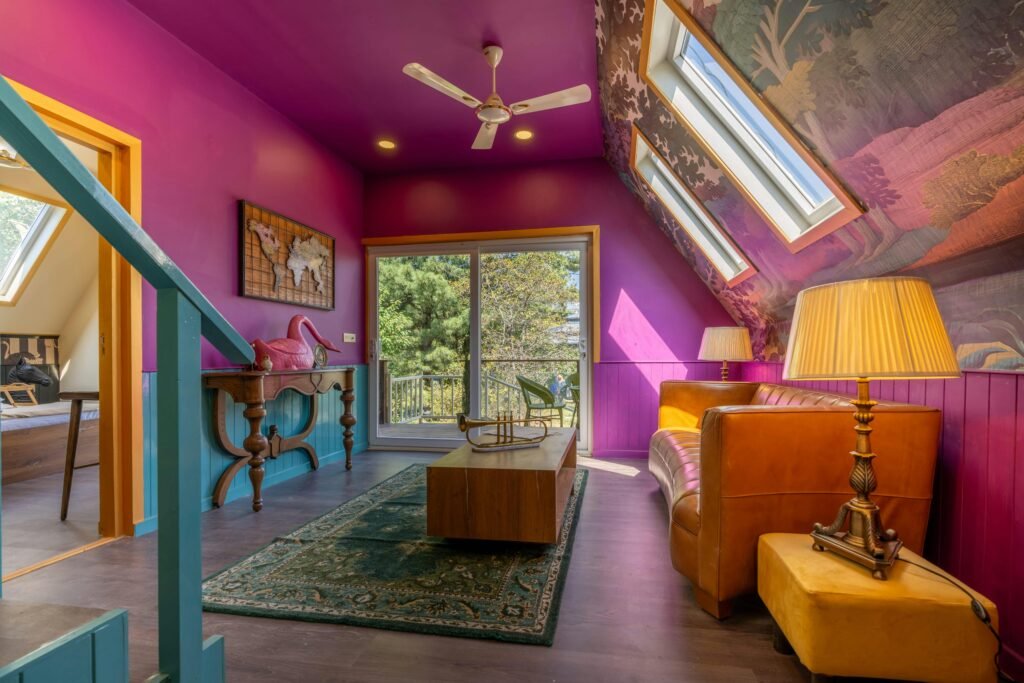
Dopamine Décor: Why Bold Colour Is Good for Your Brain
Vivid colours, clashing patterns and an unapologetic rejection of restrained neutrals: dopamine décor has been called frivolous, maximalist and even garish. It has also been linked, with increasing scientific credibility, to genuine improvements in mood, energy and creative thinking.
At some point in the past three years, a significant number of people decided that they were done with greige. Done with Scandi-neutral, done with the fifty shades of off-white, done with the carefully curated palette of dusty sage and warm putty that had dominated interior design for the better part of a decade. They reached instead for yellow, not the muted, sun-bleached yellow of a tasteful throw pillow, but a proper, committed, unembarrassed canary yellow. For cobalt blue and emerald green and terracotta orange and magenta pink. For colour, in quantity, without apology.
The trend has been given various names, but ‘dopamine décor’ has stuck, both for its neurological implication that vivid colour actively stimulates the brain’s reward system, and for its suggestion that interior design can be understood as a vehicle for emotional self-regulation rather than merely aesthetic expression. It is a trend that has attracted both enthusiasm and scepticism in equal measure. What it has also attracted, increasingly, is serious scientific interest.
The Neuroscience of Colour
The relationship between colour and human psychology is ancient as an observation and surprisingly young as a science. The Impressionist painters understood intuitively that colour had emotional weight. It was not until the twentieth century that researchers began to systematically quantify those effects, and the picture that has emerged is considerably more complex, and considerably more interesting, than the simple hue-to-mood mappings that popular psychology has long promoted.
Colour perception begins in the retina, where cone cells sensitive to different wavelengths transmit signals that the visual cortex processes into the experience of colour. But colour processing does not stop in the visual system. Neuroimaging research has established that colour activates areas of the brain associated with emotional processing, memory and reward, including, crucially, the mesolimbic dopamine pathway, the brain’s primary reward and motivation circuit. This is the neurological basis for the trend’s name, and while the marketing has inevitably simplified a complex mechanism, the underlying science is real.
Research by the Institute of Color Research suggests that people make subconscious judgements influenced by colour within ninety seconds of encountering a new environment, with colour accounting for up to 90 percent of the initial impression. Studies on colour and cognitive performance consistently find that different colours activate different cognitive modes: red environments tend to enhance performance on detail-oriented tasks; blue environments promote creative and associative thinking; saturated colours in general improve alertness compared with muted ones.
“Joy is not frivolous. The ability to feel pleasure in your environment is a genuine wellbeing resource. Colour is one of the cheapest and most accessible ways of accessing it.”, Dr Sophie Crane, colour psychologist
What ‘Dopamine’ Actually Means Here
The term ‘dopamine décor’ is, to be precise about it, a metaphor, and like most neuroscientific metaphors that find their way into popular culture, it has been both clarified and complicated by the researchers who study the actual neuroscience. Dopamine is not, as it was once characterised, simply the brain’s pleasure chemical. It is more precisely a signalling molecule involved in reward anticipation, motivation and the learning of rewarding behaviours. It is released not only when we experience something pleasurable but when we anticipate pleasure, when we see something novel, unexpected or stimulating.
‘Colour, particularly high-contrast, saturated colour in combinations that are unexpected, is genuinely novel to the visual system in a way that neutral colours are not,’ says Dr Sophie Crane, a colour psychologist at the University of Edinburgh. ‘That novelty has measurable effects on attentional systems and on the activation of reward circuits. Whether you call that dopaminergic or not is a semantic question. That it does something to how people feel in a space is not.’
The Post-Pandemic Permission
Dopamine décor did not emerge from nowhere. Its timing, flowering in 2021 and accelerating through 2022 and 2023, reflects a very specific moment in collective psychology. Two years of pandemic lockdowns, lived largely within the four walls of whatever space a person happened to occupy, produced a notable shift in attitude toward those spaces. For many, the home that had been experienced as insufficient or temporary suddenly required to be genuinely liveable, to deliver not merely shelter but something closer to joy.
At the same time, a broader cultural permission to prioritise emotional wellbeing over social convention, accelerated by the pandemic’s disruption of normal life, made the aesthetics of restraint feel newly like a form of suppression. The argument that one’s home should be visually cautious, that taste required holding back, felt suddenly hollow in a context where the alternative was another year of magnolia.
The result was a spending shift that retailers, paint manufacturers and homeware brands were quick to recognise and accommodate. Farrow & Ball launched richer, more saturated formulations. IKEA introduced more vivid upholstery options. Smaller independent makers of maximalist textiles and ceramics, many of whom had previously operated in a niche market, found themselves speaking to a mainstream audience.
The Backlash and the Evidence
The pushback was predictable: dopamine décor was characterised as garish, as a reaction rather than a considered aesthetic, as the interior design equivalent of eating too much sugar. Some of the criticism was fair. A space saturated with high-intensity colour in every plane, without tonal contrast or visual breathing room, can produce overstimulation rather than joy; particularly for people who are introverted, highly sensitive or working through anxiety.
But the evidence does not support a wholesale rejection of colour in domestic spaces. Studies on the relationship between colour saturation and mood consistently find that moderate increases in environmental colour saturation are associated with improved mood and reduced feelings of fatigue. Research on colour therapy, used in clinical settings with growing frequency, finds benefits for anxiety, depression and pain management, with warm and vivid hues generally associated with improved mood and energy.
What the evidence suggests, broadly, is that the relationship between colour and wellbeing is personal, contextual and mediated by individual factors including personality, cultural background and cognitive style. The optimal domestic palette for a highly sensitive introvert may look very different from that for an extroverted creative professional. What both share, according to the research, is that choosing a colour environment deliberately, rather than defaulting to neutral, is associated with greater satisfaction with one’s home and, by extension, with greater subjective wellbeing.
The trend will evolve, as all trends do. The canary yellows and cobalt blues of 2022 will be replaced by something slightly different. But the underlying proposition (that our homes can and should make us feel good, and that colour is a powerful and legitimate tool for achieving that) is not a trend at all. It is a return to something we forgot: that joy is a valid design brief, and that there is nothing trivial about living in colour.