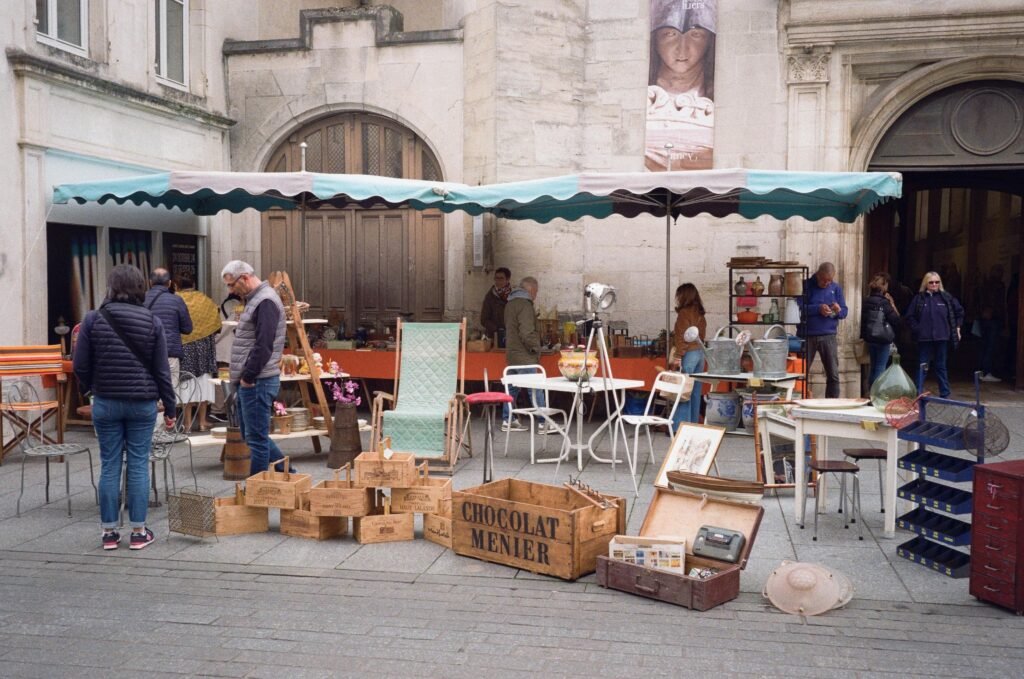
The Second-Hand Furniture Boom and What It Means
Charity shops are being emptied by young professionals. Vinterior and eBay are the new IKEA. The second-hand furniture market is booming, and it says something important about how our relationship with objects, quality and the environment is changing.
Not long ago, the discovery of a piece of furniture in a charity shop was a transaction conducted in mild secrecy. You might strip and repaint it, or position it where visitors would not immediately notice its provenance. The idea that its second-hand origin was a point of aesthetic and ethical pride (something to mention, even to lead with) would have seemed eccentric.
That cultural shift has now, unmistakably, happened. The second-hand furniture market in the UK grew by an estimated 27 percent between 2019 and 2023, according to data from the British Heart Foundation, which operates one of the country’s largest networks of pre-owned furniture shops. Online platforms (Vinterior, Selency, 1stDibs, and the furniture sections of eBay, Facebook Marketplace and Gumtree) have transformed access to pre-loved pieces, connecting buyers with sellers across the country in ways that the charity shop alone never could.
Who Is Buying Second-Hand
The demographic profile of the second-hand furniture buyer has changed significantly in the past decade. Where pre-owned furniture was historically associated with tight budgets and limited options, surveys by the furniture retailer Heal’s and the design platform Houzz both find that younger, more affluent buyers are now among the most active second-hand shoppers, not out of financial necessity but out of aesthetic preference, environmental conviction, and a growing disillusionment with the quality and character of new mass-produced furniture.
‘There is a very clear narrative among younger buyers about authenticity,’ says furniture historian and consultant Anna Kyme. ‘They have grown up in homes full of flat-pack furniture made to price points that required compromises in material quality and construction. They are not nostalgic for particular periods; they are nostalgic for the idea that a piece of furniture could be made to last, could be repaired rather than replaced, could mean something. Second-hand furniture often provides that. New furniture often does not.’
The environmental dimension is real, though it requires some nuance. The most sustainable piece of furniture is one that is not manufactured at all, reusing an existing piece avoids not merely the embedded carbon of new production, but the extraction, transport and processing of raw materials that new manufacturing requires. Research by the Ellen MacArthur Foundation found that extending the life of furniture by just two years reduces its carbon footprint by around 14 percent compared with replacing it.
“Second-hand furniture buyers are not nostalgia merchants. They are making a rational assessment about quality, character and environmental impact, and coming to the same conclusion.”, Anna Kyme, furniture historian
The Quality Question
The quality argument for second-hand furniture is, in many ways, the most straightforward. Much of the furniture manufactured in the second half of the twentieth century was built to standards (in timber grade, joinery quality and upholstery technique) that the current market simply does not provide at equivalent price points. A solid oak sideboard from the 1960s, purchased for £180 at a house clearance sale, will in most cases outperform a new MDF equivalent costing twice as much in both durability and repairability.
This is not uniform across all periods and styles. Mid-century modern furniture, which has experienced a sustained revival that shows no signs of abating, is now so sought-after that original pieces command prices that rival or exceed new equivalents. But across the broader second-hand market (Victorian, Edwardian, 1970s stripped pine, 1980s upholstery) quality pieces are consistently available at prices that reflect their current unfashionability rather than their structural integrity.
What It Means for Interior Design
The second-hand boom is reshaping interior design in ways that go beyond individual purchasing decisions. The ‘curated’ interior (composed of pieces from different periods, different places, different lives) has become the dominant aspiration in domestic design, replacing the coordinated room sets and matching collections that characterised the flat-pack era. Instagram and Pinterest, for all their role in driving consumption, have also communicated a powerful aesthetic proposition: that the most interesting spaces are not those where everything matches, but those where nothing quite does.
This has placed second-hand furniture not at the margins of design culture but close to its centre. The ability to recognise a Ladderax shelving system, to spot Danish teak dining chairs at a distance, to know which auction houses and dealers are worth following; this has become a form of cultural capital in the same communities that once prized knowledge of which new collections were worth ordering.
Interior designers, including those who work at the high end of the residential market, report that clients increasingly bring pre-owned pieces to the project (grandparents’ chairs, inherited dining tables, market finds) around which the design scheme must be built. This represents a fundamental inversion of the traditional design process, which begins with the scheme and populates it with new purchases.
The Limits of the Second-Hand Market
The boom has not been without its complications. Popular categories, particularly mid-century modern, have seen price inflation that is beginning to make the ethical choice significantly more expensive than the budget one. The ‘democratisation’ narrative around second-hand design has come under scrutiny as dealers and flippers drive up prices in exactly the markets (charity shops, house clearances) that once made pre-owned furniture accessible to those with limited means.
Nevertheless, the direction of travel is clear. The idea that a home composed primarily of new, brand-purchased furniture from a small number of retailers represents the aspirational norm is losing ground, to the second-hand market, to independent makers, to the inheritance and repair culture that the boom has also stimulated. Furniture is beginning, slowly, to mean something again.