The Colour Theory for Makeup
Artists have used the colour wheel for centuries. Makeup artists use it every day. Here is why understanding it will change the way you approach your whole face.
Why Colour Theory Is the Foundation of Every Great Look
Walk into any professional makeup lesson and the first thing you are likely to encounter is not a brush or a palette. It is a colour wheel. The circular diagram of primary, secondary, and tertiary hues that you may remember from school art class is, in fact, the single most useful tool in makeup application. Yet for the vast majority of people who wear makeup, it is never explained.
Understanding colour theory does not mean becoming an artist. It means understanding three things that change everything: your skin’s undertone, how colours interact with one another, and how to use contrast to direct the eye. Once you have those three concepts, every product decision you make will become more intentional and more effective.
Warm, Cool, and Neutral: Understanding Undertone
Before any colour decision can be made, you need to understand your undertone. Your surface skin tone, which is the colour your skin appears on a given day, will shift with sun exposure, health, and age. Your undertone will not. It sits beneath the surface and determines which colours will harmonise with your complexion and which will clash.
Warm undertones have a golden, peachy, or yellow base. Cool undertones lean pink, red, or bluish. Neutral undertones sit somewhere between the two. The classic tests are surprisingly reliable starting points: look at the inside of your wrist in natural light to see whether your veins appear green (warm) or blue-purple (cool), or consider whether silver or gold jewellery tends to suit you better.
Why does undertone matter for makeup? Because a foundation, a blush, a lipstick or an eyeshadow that fights your undertone will always look slightly wrong, even if the individual colour seems appealing in isolation. A golden highlighter on a deeply cool undertone can read muddy rather than luminous. A berry-toned lipstick on a warm undertone can look bruised rather than bold.
“Your surface skin tone changes with the seasons. Your undertone never does, and it is the key to every successful colour decision.”
Complementary Colours: How to Make Eyes Pop
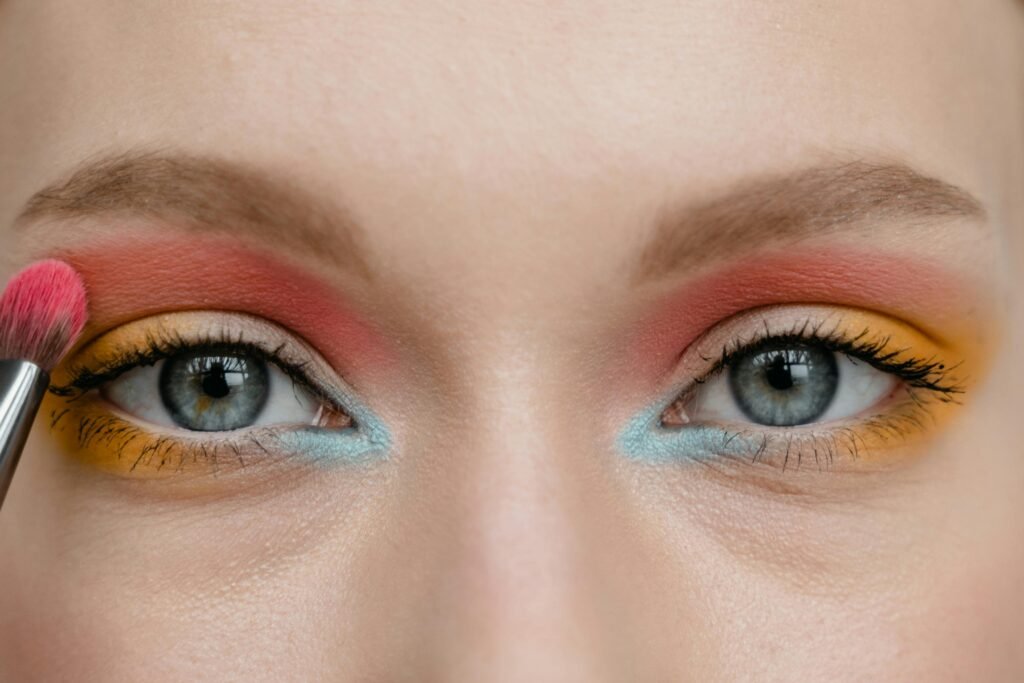
On the colour wheel, complementary colours sit directly opposite each other. Red and green are complements. Blue and orange are complements. Purple and yellow are complements. When placed next to each other, complementary colours intensify each other’s vibrancy, which is precisely why makeup artists reach for this principle when they want to make eyes appear brighter.
Green eyes, for example, are enhanced by reddish or copper-toned eyeshadows, because red and green sit opposite each other. Blue eyes appear more vivid when surrounded by warm browns and bronzes, which carry orange tones. Brown eyes, which contain both warm and cool elements, have the broadest range, responding beautifully to purples and plums.
This is also why the right flush of blusher can make the whites of your eyes appear brighter. A peachy-coral blush on a warm complexion introduces red-adjacent tones that, in complement to the slight greenish cast of the sclera, creates the appearance of wide-awake, clear eyes.
Analogous Colours and the Art of Monochrome Dressing
While complementary colours create contrast and drama, analogous colours (those sitting next to each other on the wheel) create harmony. This is the science behind the ‘monochromatic’ makeup look that has dominated editorial pages for the past several years: using the same colour family on eyes, cheeks, and lips creates an effect that is cohesive, modern, and surprisingly flattering.
Terracotta on the lids echoed in a warm rust blush and a brick-toned lip, for instance, reads as intentional and sophisticated rather than mismatched. The brain perceives the coordination as polished. Crucially, monochromatic looks are also forgiving: because there is no strong contrast between zones, uneven blending is far less visible.
“The monochromatic look works not just because it is fashionable; it works because of how the human brain perceives colour harmony.”
Colour Correcting: Using the Wheel to Neutralise
Colour theory also underpins the logic of colour correcting, which uses complementary colours not to enhance but to cancel. A green-tinted corrector neutralises redness, because green sits opposite red on the wheel. A peach or orange corrector cancels blue or purple tones, which is why deeper skin tones use orange-based concealers to neutralise dark circles, where blue-toned pigmentation is especially prevalent. Yellow correctors address purple-grey discolouration on lighter complexions.
Understanding this means you no longer need to simply pile on concealer in the hope of covering something. You can, instead, use a small amount of the correct complementary corrector first, and then cover with a fraction of the product you would otherwise have used.
Colour and Light: The Final Consideration
Any serious conversation about colour in makeup must include one essential variable: light. The way colours behave changes dramatically depending on whether you are seen in daylight, tungsten light, fluorescent light, or candlelight. Makeup that looks perfectly blended in natural light can appear flat or garish in artificial settings.
The professional standard is to do your makeup, or at least check it, in the light you will actually be seen in. For everyday wear, applying near a window remains the gold standard. For evenings out, a warm-toned bulb mirrors restaurant and venue lighting far better than the cool-blue overhead lighting found in most bathrooms.
Colour theory is not a guarantee of perfection. But it is the closest thing to a reliable framework for understanding why some combinations work instinctively and others never seem to, no matter how much effort goes in. Use the wheel, understand your undertone, and the guesswork begins to dissolve.
| The Colour Theory Essentials |
|---|
| Identify your undertone (warm, cool, neutral), as it never changes and guides every colour decision |
| Use complementary colours (opposites on the wheel) to intensify eye colour and brighten skin |
| Analogous colours (neighbours on the wheel) create cohesive, modern monochromatic looks |
| Colour correcting uses complementary tones to neutralise discolouration, not merely cover it |
| Always check finished makeup in the light you will actually be seen in |