Knife Skills: The Techniques Every Cook Needs
The knife is the most used tool in any kitchen, yet most people never learn to use one properly. These techniques will make you faster, safer, and significantly more comfortable at the chopping board.
The Correct Grip (and Why It Matters)
Most people hold a kitchen knife by the handle. Professional cooks hold it by the blade. This sounds alarming, but the pinch grip involves holding the flat of the blade between the thumb and index finger just ahead of the handle, and it gives far greater control while reducing fatigue over longer sessions. The remaining fingers wrap around the handle naturally.
The pinch grip keeps the blade steady, prevents it from twisting in your hand, and allows you to guide the knife with precision rather than forcing it through food. If you have never used this grip before, it will feel strange at first. Within a week of consistent practice, it will feel like the only sensible way to hold a knife.
The Claw: Your Most Important Safety Habit
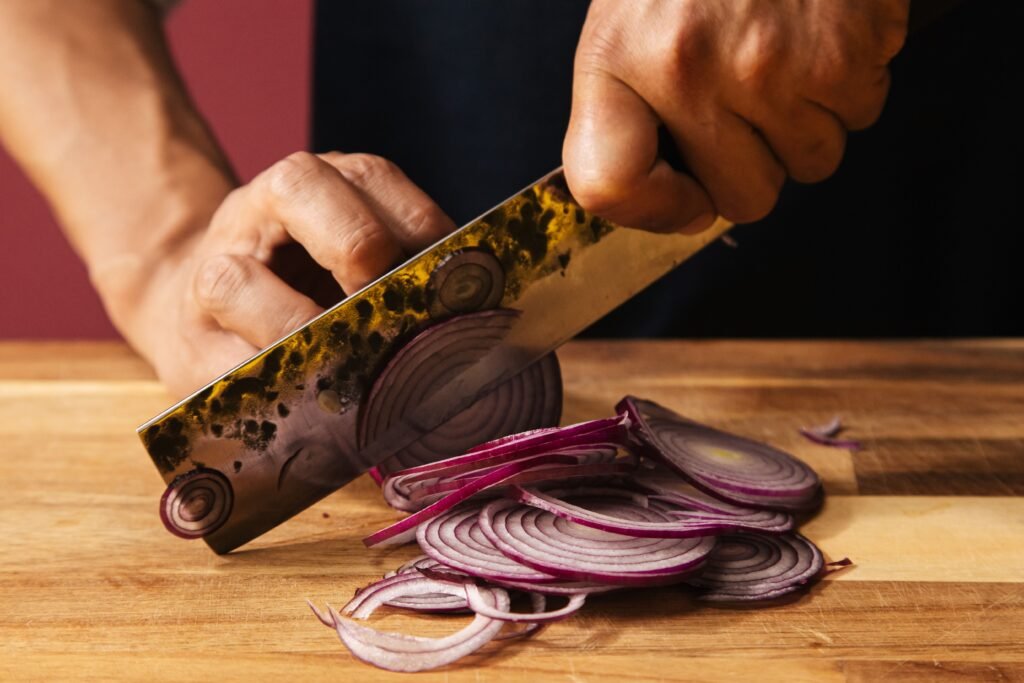
The second foundational technique is the claw: the position of your non-dominant hand as it holds food steady on the board. Curl your fingertips under so that your knuckles face the blade, and use the flat side of the blade to guide against those knuckles as you cut. Your fingertips are tucked away and protected; the blade rides along the knuckle line.
This technique does two things simultaneously. It protects your fingers and it creates a guide rail for consistent, even cuts. Every professional kitchen teaches it, and the reason it is universal is simple: it works. Inconsistent cuts are more than an aesthetic problem. Uneven pieces mean some parts overcook before others are done, which is the hidden cause of many disappointing meals.
The Three Cuts You Use Every Day
The rocking chop is the most versatile cut for herbs, garlic, and soft vegetables. Keep the tip of the knife in contact with the board and rock the heel up and down, moving the food gradually under the blade. The tip stays grounded; the work happens at the middle of the edge.
The push cut is used for firm vegetables, meat, and fish. The knife moves forward through the food as the blade descends, using the full length of the edge in a smooth, slicing motion. It produces clean cuts with minimal tearing.
Julienne, or matchstick cutting, produces uniform strips. Cut the vegetable into planks first, then stack the planks and cut across them into strips. Consistent julienne is the basis for any dish where vegetables need to cook quickly and evenly, from stir fries to dressed salads.
“Inconsistent cuts are more than an aesthetic concern. Uneven pieces mean some parts overcook before others are done, which is the hidden cause of many disappointing meals.”
Sharpness Is a Safety Variable
A blunt knife is more dangerous than a sharp one. This is counterintuitive but mechanically straightforward: a blunt blade requires more pressure to cut through food, which means the knife is more likely to slip off the surface and toward your fingers. A sharp knife requires less force, remains in contact with the food, and cuts cleanly.
A honing steel, used before each session, realigns the blade edge and maintains sharpness between full sharpenings. A whetstone or a pull-through sharpener restores the actual edge when honing is no longer sufficient, which for regular home use is typically every few months. A sharp knife glides cleanly through a sheet of paper without tearing.
Board Position and Station Setup
Your chopping board should not move. Place a damp cloth or a piece of damp kitchen paper beneath it to keep it anchored to the counter. A sliding board is dangerous and undermines every technique listed above.
Keep your knife within reach, your waste bowl to one side, and move your prepared ingredients in one consistent direction, raw on one side, chopped on the other. Professional cooks call this mise en place, having everything in its place before cooking begins. Even a simplified version of this principle reduces kitchen chaos and makes the cooking process feel more manageable and genuinely enjoyable.
| Knife Skills: The Essentials |
|---|
| Use the pinch grip (blade between thumb and index finger) rather than gripping only the handle, for control and precision |
| The claw position protects fingers and creates a guide rail for even, consistent cuts |
| Rocking chop for herbs and soft vegetables; push cut for firm foods and proteins; julienne for uniform matchstick strips |
| Sharpness is a safety feature: a blunt knife requires more force and is more likely to slip |
| A damp cloth under the chopping board keeps it stable and prevents accidents |