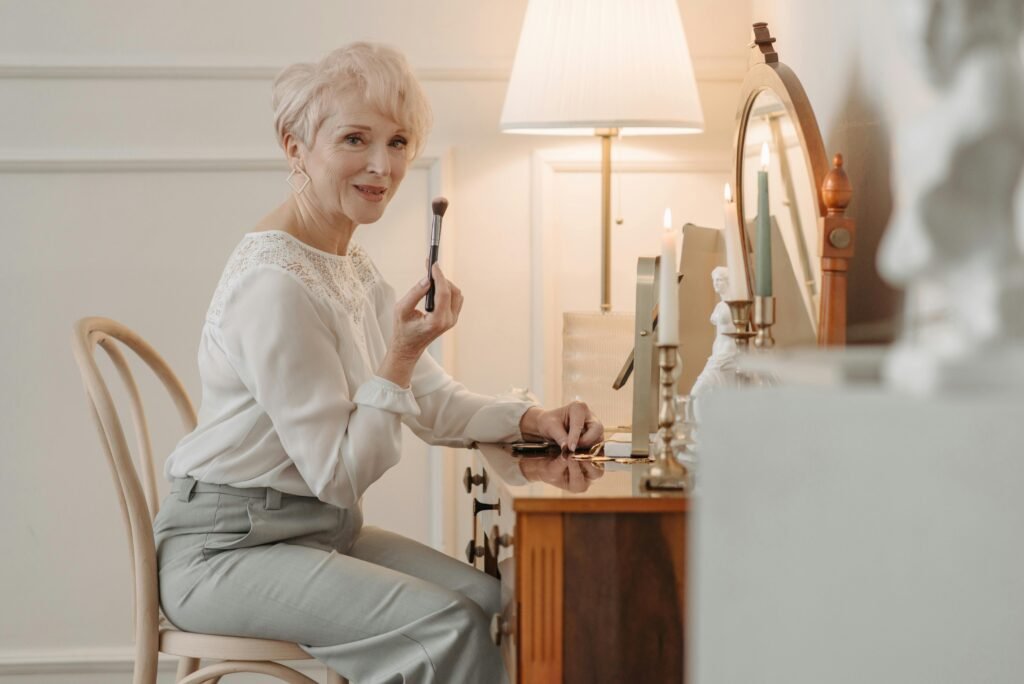
How the Skincare Industry Misleads Women Over 40
Billions are spent every year on creams, serums and treatments promising to reverse ageing, but many of the most aggressively marketed products for midlife skin are built on shaky science. A growing body of research is pushing back.
The Anti-Ageing Industrial Complex
Walk into any department store beauty hall and the messaging directed at women over 40 is relentlessly, almost violently, consistent: your skin is a problem that requires solving. Firmness is ‘lost’. Elasticity is ‘declining’. Radiance needs to be ‘restored’. The language of clinical emergency has been quietly colonised by skincare marketing, and it is extraordinarily profitable.
The global anti-ageing skincare market was valued at over $60 billion in 2023 and is projected to exceed $93 billion by 2030, according to Grand View Research. A significant portion of that growth is driven by products targeting women in perimenopause, menopause, and beyond, a demographic that industry analysts describe, with barely concealed excitement, as ‘underserved’ and increasingly willing to spend.
But dermatologists, biochemists and consumer advocates are raising uncomfortable questions about whether the ingredients in many of these products do what the packaging claims, and whether the clinical language used to sell them meets any meaningful standard of proof.
“The term ‘clinically proven’ in skincare marketing is almost entirely meaningless. Ask: proven by whom, to what standard, on how many people?”
What Changes in Skin After 40, and What Doesn’t
To understand what the industry is selling, it helps to understand what genuinely changes in skin during midlife. After 40, oestrogen levels begin their long, gradual decline, a process that accelerates in perimenopause. Oestrogen plays a meaningful role in skin physiology: it supports collagen synthesis, helps maintain skin thickness and moisture retention, and influences the turnover rate of skin cells.
Studies published in journals including the British Journal of Dermatology have found that skin loses approximately 30% of its collagen in the first five years after menopause, with a slower decline thereafter. Skin also becomes drier as sebaceous gland activity decreases, and the skin barrier, the outermost layer that protects against environmental damage, becomes more permeable.
None of this is catastrophic. These are biological processes, not diseases. But they are real, and they do mean that skin in midlife has genuinely different needs to skin at 25, which makes it all the more frustrating that so much of what is marketed specifically for this age group is based on misleading claims.
The Problem with ‘Clinically Proven’
Perhaps no phrase in the beauty industry does more work with less accountability than ‘clinically proven’. Regulated medical products (pharmaceuticals, for example) must demonstrate efficacy through randomised controlled trials with large sample sizes, peer-reviewed results and regulatory approval. Skincare products face no such requirement.
‘Clinically tested’ or ‘clinically proven’ on a moisturiser label typically means the brand commissioned its own study, often with as few as 20 to 30 participants, over a short timeframe, with subjective measures such as how participants rated their own skin after use. These are not the same standards applied in medicine, and the results are rarely, if ever, published in peer-reviewed journals.
Dr. Justine Hextall, a consultant dermatologist and member of the British Skin Foundation, puts it plainly: “The language used in cosmetic advertising borrows heavily from clinical medicine, and consumers over 40 are particularly targeted because they are more likely to be motivated by efficacy rather than trend. But ‘clinically proven’ in this context has a very different meaning to what most people assume.”
Ingredients That Work, and Ones That Don’t
The good news is that there is a clear, evidence-backed shortlist of ingredients that genuinely address the changes midlife skin undergoes. The less good news is that many of the most heavily marketed ‘innovation’ products for this age group rely on proprietary complexes and trademarked compounds with little independent supporting research, while omitting or underusing the ingredients that do have a solid evidence base.
What the evidence supports for skin over 40:
Retinoids (including prescription tretinoin and OTC retinol): the most robust body of evidence for stimulating collagen production, improving skin texture and addressing hyperpigmentation. The catch is that they cause irritation in many users and must be introduced gradually.
Broad-spectrum SPF: the single most evidence-supported ‘anti-ageing’ intervention. UV damage is responsible for up to 80% of visible skin ageing. No serum compensates for inadequate sun protection.
Niacinamide: well-evidenced for improving skin barrier function, reducing redness and addressing uneven tone. Particularly valuable as oestrogen decline compromises barrier integrity.
Peptides: emerging but promising evidence for collagen support, though results depend heavily on formulation and penetration.
Hyaluronic acid: excellent for surface hydration, though its benefits are largely temporary and cosmetic rather than structural.
The Menopause Skincare Boom
In recent years, a new sub-category has emerged: products specifically marketed for ‘menopausal skin’. These are often priced at a significant premium over comparable products and frequently reference hormonal changes on their packaging, implying a biological specificity they cannot deliver on, because cosmetics, by definition, cannot affect the body’s hormonal systems.
A face cream cannot raise oestrogen levels. It cannot affect the hormonal cascade that drives the physiological changes of menopause. What it can do is address some of the surface manifestations (dryness, sensitivity, uneven texture) if it contains the right ingredients. But those ingredients are not unique to ‘menopausal’ products. A well-formulated general moisturiser with ceramides, niacinamide and SPF is likely to outperform an expensive ‘menopause’ cream that relies on vague ‘phyto-hormone’ complexes.
This is not to say that the wave of attention directed at midlife skin is without value. Greater awareness that skin needs shift significantly during this period is genuinely useful. The problem is when that awareness is monetised through overpriced products with disproportionate marketing and underdelivering formulas.
“A well-formulated general moisturiser will outperform an expensive ‘menopause cream’ every time, if you know what to look for.”
What Consumers Can Actually Do
The most effective approach to midlife skincare is, in some ways, the least marketable: it involves a small number of proven ingredients, consistent habits, adequate sun protection, and realistic expectations. It is not a six-step regime of proprietary serums.
Dermatologists broadly agree on a streamlined framework: a gentle cleanser that does not strip the skin barrier; a broad-spectrum SPF of at least 30 (ideally 50) applied daily; a moisturiser with ceramides and niacinamide to support barrier function; and, if tolerated, a retinoid used several evenings a week. For significant concerns about pigmentation, texture or collagen loss, in-clinic treatments (such as chemical peels, laser resurfacing or microneedling) have a far stronger evidence base than any over-the-counter product.
The packaging may not be glamorous. The marketing may not tell you that this is a luxury treat for women who ‘deserve’ to feel their best. But the science is considerably more reliable, and that, for consumers who have spent decades being sold a bill of goods, may be the most refreshing thing of all.