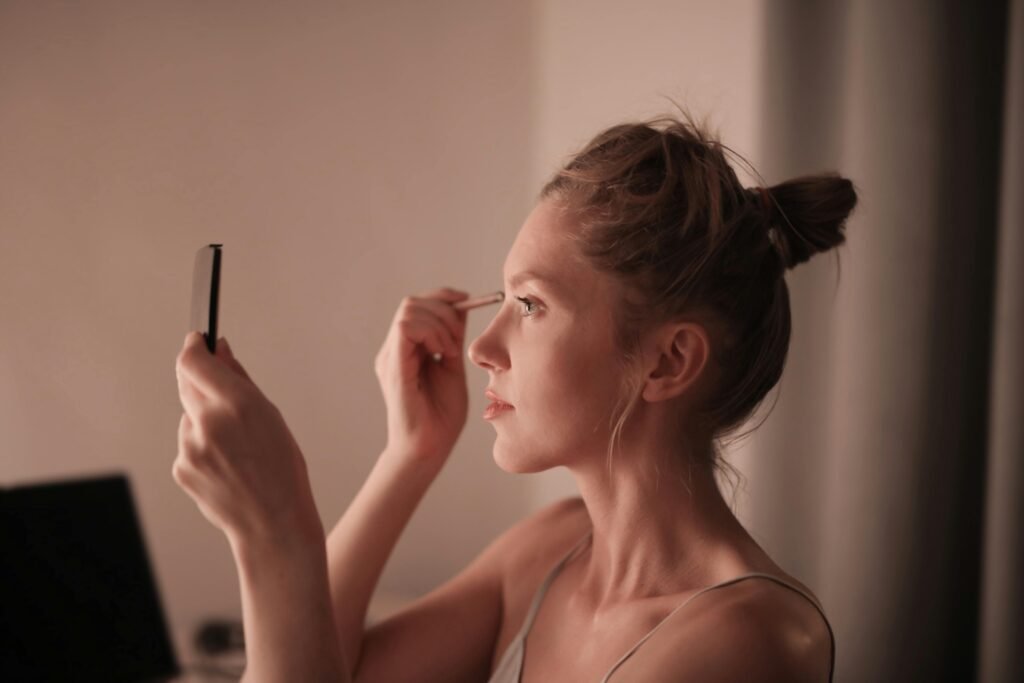
Why No-Makeup Makeup Is the Decade’s Most Political Look?
It looks effortless. It takes 45 minutes. And depending on who is wearing it, it signals everything from quiet feminism to corporate conformity to a new kind of beauty coercion. The ‘no makeup makeup’ trend is far more complicated than it appears.
The Paradox in the Mirror
At its surface, the no makeup makeup look is a straightforward beauty directive: appear as though you have applied nothing while having, in fact, applied quite a lot. A tinted moisturiser. A brow gel. A coat of mascara carefully applied and then partially removed. A product called ‘skin tint’ or ‘blurring serum’ that suggests no artifice while correcting every pore. The overall effect should read as natural, healthy and unembellished; which is to say, it should look like nothing at all.
This is not new. The desire to appear effortlessly beautiful without appearing to have made any effort is as old as modern cosmetics. What has changed, significantly, is the cultural context in which no makeup makeup is now operating, and the degree to which a deliberately constructed look of naturalness has become politically loaded.
A Brief History of Performing Effortlessness
The insistence that beauty be effortless has deep roots in the history of femininity. The French concept of je ne sais quoi, the suggestion of beauty that cannot be pinned down or explained by any single feature or technique, is in many ways an ancestor of the no makeup look. Women throughout the twentieth century were exhorted to appear attractive without seeming to try too hard, which is a particular form of gendered labour: not only must the beauty standard be met, but the work of meeting it must be invisible.
In the 1990s, the look of grunge and supermodel minimalism, Kate Moss’s bare skin and undone hair, appeared to repudiate the gilded excess of 1980s beauty, while simultaneously demanding a very specific kind of angular, almost otherworldly thinness that represented anything but effortlessness for most women. The message was: look natural, but look naturally perfect.
The 2000s brought heavy, sculpted makeup to the mainstream via reality television and celebrity culture. The 2010s introduced contouring and full-coverage foundation as aspirational norms. And then, roughly around 2018 to 2020, the pendulum began its current swing back towards the ‘bare’ look, driven partly by skincare culture, partly by wellness aesthetics, and significantly by social media’s ability to make a highly processed image appear unprocessed.
“We have created a beauty standard that requires women to look like they have abandoned beauty standards. The irony is staggering.”
The Skincare Pipeline That Built the Look
It is not coincidental that the rise of no makeup makeup has tracked closely with the explosion of skincare as a cultural phenomenon. As serums, acids, SPF education and glass-skin aesthetics moved from the specialist consumer to the mass market, accelerated hugely by the Korean beauty boom and the rise of skincare influencers on Instagram and TikTok, the emphasis shifted from covering the face with foundation to ‘investing in’ the skin itself.
This created an interesting ideological sleight of hand. The new beauty ideal was not, ostensibly, about makeup at all: it was about skin. Women were encouraged to spend significant sums on serums, treatments, tools and regimes not to look made-up but to look like themselves, at their best. The resulting look (luminous, pore-minimised, even-toned, plump) is virtually indistinguishable from a skilled light makeup application. But it carries none of the perceived artificiality of makeup, and a great deal more moral virtue.
The Class Politics of ‘Natural’ Beauty
There is a significant class dimension to the no makeup makeup look that rarely surfaces in beauty coverage. The products required to achieve convincing skin-but-better (tinted moisturisers that actually match a range of skin tones, skin-prep serums, brow lamination, lash lifts, the prerequisite skincare regime) represent a substantial financial investment. Moreover, the ‘natural’ look as it is performed in mainstream media and advertising typically relies on a very specific baseline: clear skin, symmetrical features, a certain kind of understated prettiness.
For women whose natural skin includes acne, rosacea, hyperpigmentation or visible pores, or whose features do not conform to the narrow template of the look, the pretence that this is about doing less is particularly hollow. Doing less, in these cases, does not produce the same result.
The beauty scholar Heather Widdows has argued that contemporary beauty norms function as moral norms: women who fail to meet them are not merely unfashionable but somehow inadequate, lacking in self-care or self-respect. The no makeup makeup trend, with its emphasis on ‘healthy skin’ and ‘glowing from within’, is particularly susceptible to this moralisation.
Workplace Feminism and the ‘Polished Natural’
In professional contexts, no makeup makeup has acquired a specific function: it has become the acceptable face of female ambition. Research into workplace appearance norms, including studies published in journals of applied psychology, has consistently found that women who wear some visible makeup are perceived as more competent and more likeable than those who wear none, but that heavy, visible makeup in corporate environments triggers negative stereotyping.
The no makeup look threads this needle elegantly. It performs femininity without being ostentatiously feminine. It signals effort without admitting to effort. It reads as professional, put-together and in control, without appearing to care about any of those things. In this sense it functions as a form of gendered camouflage, and its political valence is deeply ambiguous: is it a feminist refusal of overt performance, or the most sophisticated performance of all?
Where the Look Goes Next
Gen Z’s relationship with the no makeup look is characteristically contradictory. The same generation that has championed ‘skinfluencers’ and minimalist glass-skin aesthetics has also embraced maximalist, painterly, unambiguously artificial makeup as a form of creative self-expression. On TikTok, the ‘clean girl’ aesthetic (slick bun, barely-there makeup, expensive cashmere) coexists with graphic liner, bold colour and faces that make no attempt whatsoever to read as natural.
Perhaps this is where the no makeup look’s political complexity finally resolves: not in the look itself, but in the right to choose it, or not. A face that wears full glam by day and nothing by night. A face that refuses the skincare pipeline entirely. A face that enjoys the quiet art of almost-nothing. The most radical position, in a culture that has spent decades telling women what their faces should and should not look like, may simply be the freedom to decide.