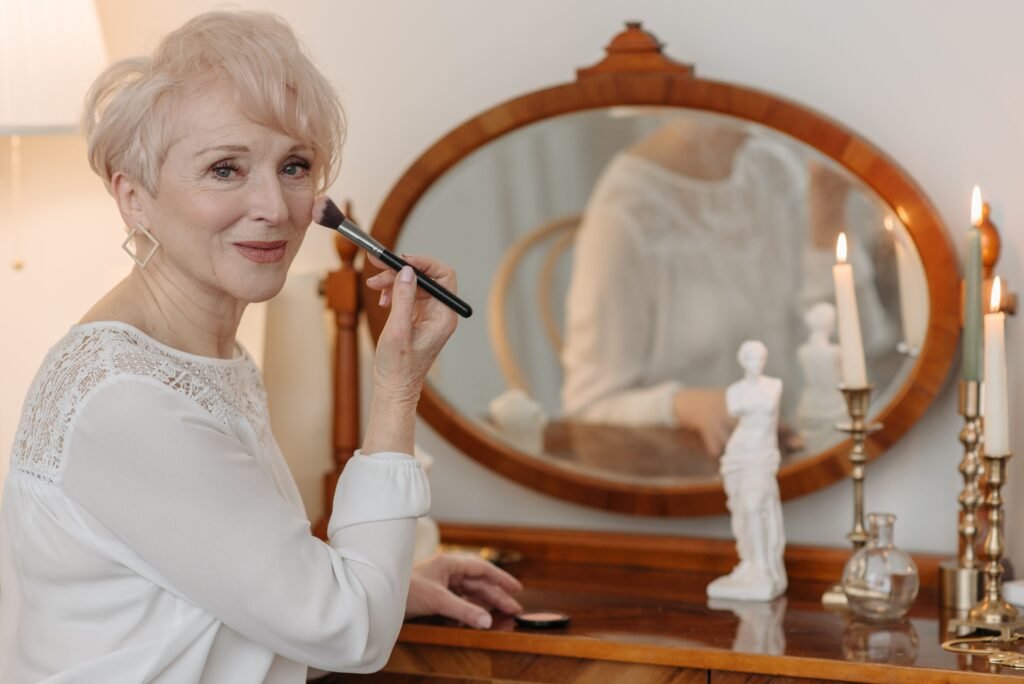
Makeup for Mature Skin: What Actually Works
The beauty industry is slowly catching up with women over forty. The techniques that work on mature skin are not more complicated; they are simply different. Here is where to start.
How Skin Changes and What That Means for Makeup
Mature skin is characterised by several structural changes that affect how makeup applies and wears. Collagen and elastin production decreases, which means skin has less firmness and bounce. Sebum production slows, making the skin drier. Cell turnover becomes slower, which can result in a more uneven surface texture. Fine lines and deeper expression lines become more visible.
None of these changes prevent the wearing of makeup. But they do shift which techniques and formulas are most effective. Products and approaches that work beautifully on younger, oilier skin, such as heavy coverage, matte formulas, and heavy powder, frequently perform differently on drier, more textured mature skin, settling into fine lines, emphasising surface dryness, and reading as heavy or mask-like.
Base Makeup: Less Coverage, More Skin
The instinct, when dealing with skin concerns like uneven tone, dark spots, or redness, is often to reach for more coverage. On mature skin, this approach tends to backfire. Heavy foundation sits on the surface rather than blending into skin, collects in pores and fine lines, and by midday has often shifted or caked.
The more effective approach is a light-to-medium coverage formula, such as a serum foundation, skin tint, or satin-finish foundation rather than a full-coverage matte, applied in thin layers with a damp sponge. The dampness of the sponge sheers the product further and prevents it from looking dry or patchy.
Spot-concealing individual areas of concern with a slightly thicker product, blended precisely with a fine brush and then pressed (not dragged) to set, allows for targeted coverage without applying a heavy base to the entire face.
“On mature skin, a thin layer of the right product is almost always more flattering than a thick layer of a high-coverage one. The goal is to look like yourself: a well-rested, luminous version of yourself.”
Concealer: The Texture and Formula That Matter
Undereye concealer is the area where most people with mature skin encounter the most difficulty. Dry, fine-lined undereye areas are notoriously prone to creasing when concealer is applied. The solutions are formula-dependent and technique-dependent.
Formulas that are very thick or that contain a high percentage of powder will crease more readily than lightweight, hydrating concealers. Apply a small amount of the lightest product that provides adequate coverage; hydrating concealers designed specifically for the undereye area tend to perform best. Warm it slightly between fingertips before applying. Pat it in gently with the ring finger (which naturally applies the least pressure) rather than dragging. Set with the minimum powder possible, preferably a finely milled translucent powder applied with a damp sponge pressed lightly into the skin rather than swept across it.
Eyes: Emphasis Over Drama
On hooded or mature eyes, the approach to eye makeup must account for the fact that the visible lid space may have reduced. Heavy, dark eyeshadow applied across a small or hooded lid can close the eye in, making it appear smaller. Lighter, skin-toned or peachy-toned shadows applied across the lid and blended upward create the appearance of more space.
Definition is more effective than drama. A smudged pencil liner along the upper lash line, tightlined on the inner rim, reads as defined and polished without requiring precision work on a reduced lid space. Mascara, particularly when applied to both upper and lower lashes with a lengthening formula, opens the eye significantly.
Avoid placing shimmer directly on a hooded lid, where it will sit in the fold rather than reflect light. Instead, shimmer is most flattering on the inner corner and the brow bone.
Lip: Preventing Feathering and Adding Fullness
Lip lines and feathering, the process of lipstick migrating into the fine lines around the mouth, become increasingly common with age as the lip border naturally softens. The practical solution is liner, applied to and slightly inside the lip border before any lipstick.
Satin and cream lipstick formulas are more flattering on mature lips than very matte formulas, which can emphasise dryness and make lips appear thinner. A gloss applied to the centre of the lower lip creates the appearance of more volume. Nude and near-nude shades that match the natural lip colour are among the most flattering and versatile for a daytime look, as they require less precision to apply and are forgiving of any slight feathering.
“Cream and satin lipstick formulas are almost universally more flattering on mature lips than mattes, because they move with the lip rather than sitting on its surface.”
The Powder Question: Less Is Always More
Setting powder is important for longevity, but on mature skin it must be used with restraint. A heavy layer of powder, particularly a finely milled but densely applied translucent powder, settles into fine lines throughout the day, creating a crepey, powdery finish that ages the face. The solution is to apply powder only where it is genuinely needed (typically the T-zone, if oiliness is still a concern, or targeted undereye setting), using a small, dense brush or a damp sponge pressed lightly into the skin rather than swept. A luminous or dewy finish is generally more flattering than a fully matte one.
| Mature Skin Makeup: What to Remember |
|---|
| Lighter coverage applied in thin layers is almost always more flattering than heavy full coverage |
| Use a damp sponge for base application, as it sheers product and prevents a dry, patchy finish |
| Hydrating, lightweight concealer for under eyes; set with minimal finely milled powder, pressed rather than swept |
| Avoid placing shimmer on a hooded or small lid; reserve it for the inner corner and brow bone |
| Use satin and cream lip formulas over mattes; liner applied first prevents feathering |