Why Open-Plan Living Is Finally Falling From Favour
For two decades it was the aspiration of every property show and new-build developer. Now architects, psychologists and exhausted families are questioning whether tearing down walls was ever really such a good idea.
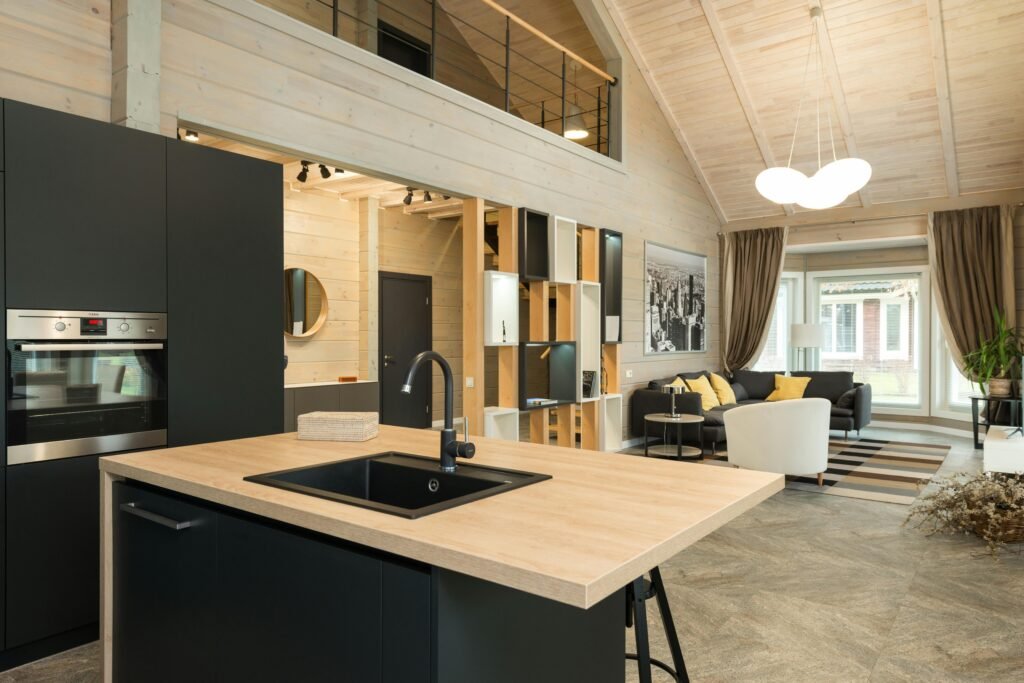
There is a particular kind of cognitive dissonance that comes from standing in a beautiful, open-plan kitchen-diner and realising you can smell the fish your partner cooked three hours ago, hear the precise dialogue of the cartoon your child is watching from the other end of the room, and see every piece of unwashed crockery from your supposedly relaxing sofa. This is the reality (unglamorous, chaotic and acoustically unforgiving) that open-plan living rarely advertises.
After more than two decades of dominance, the open-plan layout is falling quietly but decisively out of favour. Architects are being asked to partition spaces that were specifically knocked through in previous renovations. Estate agents report growing buyer interest in homes with defined, separate rooms. Interior designers speak of a new client brief with almost ritualistic consistency: ‘We want somewhere to actually close a door.’
The Pandemic Reckoning
Covid-19 did not kill the open-plan layout, but it very nearly did. When homes became simultaneously offices, classrooms, gyms and sanctuaries in 2020, the absence of acoustic and visual privacy became not merely inconvenient but genuinely destabilising. Research published in the journal Applied Ergonomics found that employees working from home in open-plan domestic spaces reported significantly higher levels of cognitive fatigue and reduced productivity compared with those who could work behind a closed door, even a flimsy one.
‘The pandemic revealed what open-plan spaces had always failed to solve,’ says Dr Layla Hassan, an environmental psychologist at University College London. ‘Human beings have deeply evolved needs for territory and retreat. We need spaces that are unambiguously ours, at least sometimes. Large undifferentiated rooms do not satisfy that need.’
Paradoxically, the same moment that exposed open-plan living’s weaknesses also made home renovation newly fashionable. Stuck inside and suddenly hyper-conscious of how their spaces functioned, homeowners in Britain began remodelling in record numbers. Planning applications for home extensions and alterations rose sharply in 2020 and 2021, and among them was a quieter but significant counter-trend: people asking not just to extend, but to divide.
“We need spaces that are unambiguously ours, at least sometimes. Large undifferentiated rooms do not satisfy that need.”, Dr Layla Hassan, UCL
The Acoustics Nobody Talked About
The marketing language around open-plan spaces (‘flow’, ‘connection’, ‘light’) has always been aspirational. What it has rarely mentioned is noise. A 2022 study by the Building Research Establishment found that noise pollution within the home is one of the most cited sources of household stress in the UK, and that open-plan households reported notably higher levels of noise-related conflict than those with conventionally divided rooms.
The physics are unforgiving. Sound, unlike smell, does not discriminate by room. In a space without acoustic barriers, a dishwasher, a television, a video call and a child’s homework dispute can coexist at volumes that make concentration, or meaningful conversation, almost impossible. Architects increasingly speak of ‘acoustic zoning’ as a fundamental design requirement rather than a luxury afterthought.
‘We spent a decade talking about natural light and sightlines,’ says Harriet Oakes, a London-based architect who has worked on residential projects across the UK. ‘We barely discussed what those spaces would sound like. That has changed completely. Now noise is the first thing clients raise.’
What Developers Are Doing Differently
New-build developers, among the most enthusiastic promoters of open-plan layouts during the 2000s and 2010s, are beginning to hedge their bets. Taylor Wimpey, Persimmon and Barratt Developments have all introduced floor plans in recent years that offer at least partial separation between kitchen and living areas. Partly this reflects changing buyer sentiment, and partly it reflects the realities of acoustic performance standards tightening under Part E of the Building Regulations.
‘Buyers are more sophisticated than they used to be,’ says Daniel Ashford, a new homes sales director at a major South East developer. ‘They come to show homes and they ask: where would I work from home? Where could I put the children when they need to do homework? Where would I go if I wanted quiet? Those are not questions that open-plan spaces answer well.’
The Return of the Room
What is emerging in place of the open-plan ideal is not, notably, a return to the cramped, compartmentalised Victorian terraced house. Rather, architects and designers describe a more nuanced hybrid: spaces that retain some connection and light while reintroducing meaningful separation through partition walls, interior glazing, double doors, and carefully positioned built-in storage that functions as a room divider.
The Japanese concept of ma, the use of space and pause to create meaning, has entered mainstream interior design conversation. So has the Scandinavian notion of the alkove, a recessed space within a room that provides visual and psychological shelter without full enclosure. Both reflect the same underlying insight: that we need rooms to mean something again.
‘People are tired of living in one big performance space,’ says interior designer Rosa Mercer, whose studio has worked on residential projects from Glasgow to Cornwall. ‘They want their kitchen to be a kitchen. They want their sitting room to be somewhere they actually sit and feel settled. That sounds obvious, but for twenty years it was almost countercultural to say so.’
The open-plan era will leave its mark. Kitchens will remain more sociable than they were in 1975. Natural light will remain a priority. But the instinct to knock every wall down, to create seamless expanses from front door to garden, is ebbing. The door is being quietly, thankfully, closed.